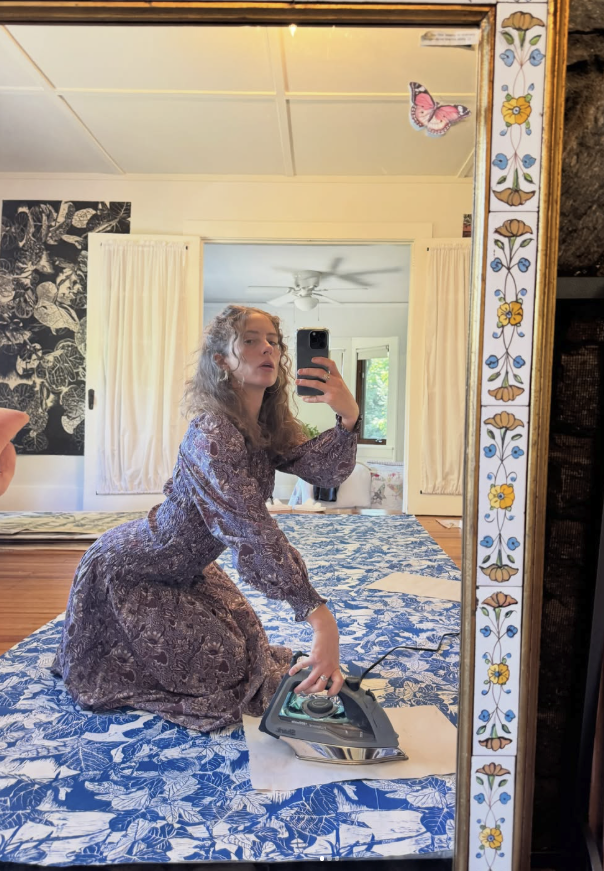
Emma Sarver
Through meticulous observation of the natural world, I explore the descriptive qualities of plants in my work as a way to both understand and redefine them. Much of my practice revolves around turning one form into another through scale, repetition, and pattern. In my prints, I use these tools as filters that allow me to generate an experience which diverges from the original form, while simultaneously holding space for whatever it was that sparked my initial observation.
The plants I choose to look at are not from any one specific place. From the Appalachian Mountains of North Carolina, my birthplace, to the swampy flatlands of New Orleans, each new landscape, while unique, is equally generous in its beauty, providing fertile ground to explore pattern, texture, and form.
Plants are inherently architectural—rooted yet adaptable, delicate yet resilient. The staghorn fern, an epiphyte, thrives without a traditional root system, instead anchoring itself to other trees in pursuit of light. The magnolia, bold and impossible to ignore, produces fruit which at the height of its maturity, releases individual bright red seeds suspended on slender threads.
The rhododendron, steadfast through the seasons, curls inward for protection in the cold and unfurls again with warmth. These forms represent my own deep need for grounding, my attraction to consistency, cycles, and the tension between stability and change.
Often, I strip plants of their environments, reducing them to their purest forms so they float in negative space—freed from a literal sense of place—allowing me to construct or obscure their structures through layering. Gingham, a pattern historically linked to domesticity and order, acts as both a support and a barrier, taming the wildness of organic forms while simultaneously revealing and concealing them.
I am also interested in the notion of resilience in the natural world. When given the right conditions, plants can continue to multiply and reproduce. My work explores this fruitfulness in its multiplicity. My prints examine how structure shapes our experience of nature and place. What happens when we impose order upon the wild? What is revealed when layers are stripped away or added in abundance? What is lost or gained when we construct our own systems of grounding? My work exists within this tension—between growth and containment, between freedom and the desire to root.